 Years ago there was a fellow expatriate - a Welshman - at a school I taught at in Ghana. We'll call him by his initials , A J. (You can probably guess what the J stands for). AJ painted in his spare time, strange fusions of European and African art , mixing Roman Catholic and animist imagery - and liked to disport himself as a creative type. This was a reflection he said of his Celtic genes. The Celts he said, were the original pre-Roman inhabitants of Britain, with a long cultural tradition, in contrast to myself, a West Londoner, who was an Anglo-Saxon - a Johnny- come -lately . You had to hand it to the Anglo-Saxons , he said - they certainly had practical skills- but in most other respects they were cultural philistines, lacking a soul.
Well, A, I wish you were here right now, reading this blog. Does the name Stephen Oppenheimer mean anything to you ? If not, then you are in for a big surprise, along with probably millions of other who think or assume that Britons divide into two groups:
1. Anglo-Saxons in the heartlands, invaders from mainland Europe following the departure of the Romans
2. The Celtic fringe - the "real" Britons, driven off the plains, and into the hills and mountains by those fierce warlike Nordic and Germanic invaders .
You see, according to Stephen Oppenheimer, who's a genetics Professor at Oxford University, there's really not a lot of difference, genetically speaking, between Brits in the heartland, and those at the fringes. In fact to label them Anglo-Saxons and Celts is totally misleading, because only 10% -20% or so of their genes on average derive from either of those two ethnic stocks. The remainder are all of the same origin, and if you don't know, or haven't heard yet, what that is, then prepare to have your socks blown off.
Because according to Oppenheimer, we inherited most our present genes from Basque ancestors in pre-history. And that's true whether you are English, Scottish, Welsh or Irish !
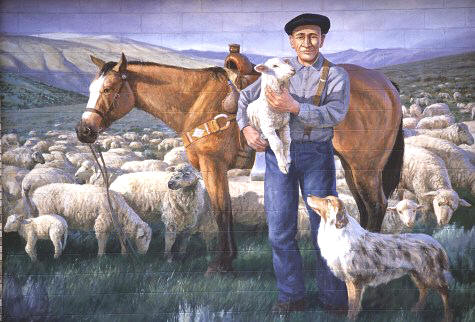
Thus the title of this piece, and the graphic above of the Basque shepherd at peace with the world.
This is quite a big subject to tackle, and my role here will be merely that of facilitator. I have little if anything by way of specialist knowledge, but when something interests me, then I waste no time in using first my battered Joy of Knowlege Encyclopaedia, circa 1980, and then this wonderful Internet to get acquainted.
Today's instalment will centre of the mysterious Basque language, and what it tells us, or doesn't, about the origins of the Basque identity.
Tomorrow's is about the modern and exciting genetic evidence that Oppenheimer has gathered to support his view that we Brits are for the most part derived from Basques who emigrated to the British Isles some 15000 years ago. And contrary to received wisdom, we resisted cultural assimilation by wave after wave of later settlers: the Celts, Vikings, Angles, Saxons and Normans .
One wonders what the Middle English was for "oversexed and over here". Or: "Yes, my daughter would love you to call by, Fritz, now she's nearly over her mumps. "
This is what I call a "piton post". I don't like writing for more than a half hour or so at a stretch, so will post now, so that my one or two regulars know what's in store. I'll return later, refreshed and caffeine-infused, with some more goodies. In the meantime, here's something to be looking at. Can you spot the English and Celtic tongues ? Can you also spot the Basque language ? (Click to enlarge)
ed. Oops, it doesn't enlarge. Click instead on this link to the Indo-European family tree

OK, so English and Celtic are both there on the Indo-European tree. But not Basque. So is it somewhere else - on the non I-E part of the tree ?
Nope. The simple answer is that that the Basque language, aka Euskara, has withstood all attempts on the part of scholars to link it to any other known language - either in Europe, or anywhere else in the world for that matter.
If the Basque language is unique, then it suggests strongly that its speakers are NOT long haul immigrants who had ambled in footsore from some distant part of Europe or Asia. They are truly indigenous to the present Basque region, in Northern Spain, and SW France, and have been since time immemorial. It's reckoned that the Basques were established in N Spain during the Stone Age, and probably earlier, and have been there ever since.
Put another way, they are Europe's great survivors, despite their being stubborn stay-putters. Everyone else around – the Catalans, the Castilians for example - all are new kids on the block, with the proviso that each page in your calendar represents a millennium.
What about Basque as a language ? If you want to hear how it sounds, here's a fun website, where you can hear Basque spoken
Here's what it look like when you get there (click to enlarge):
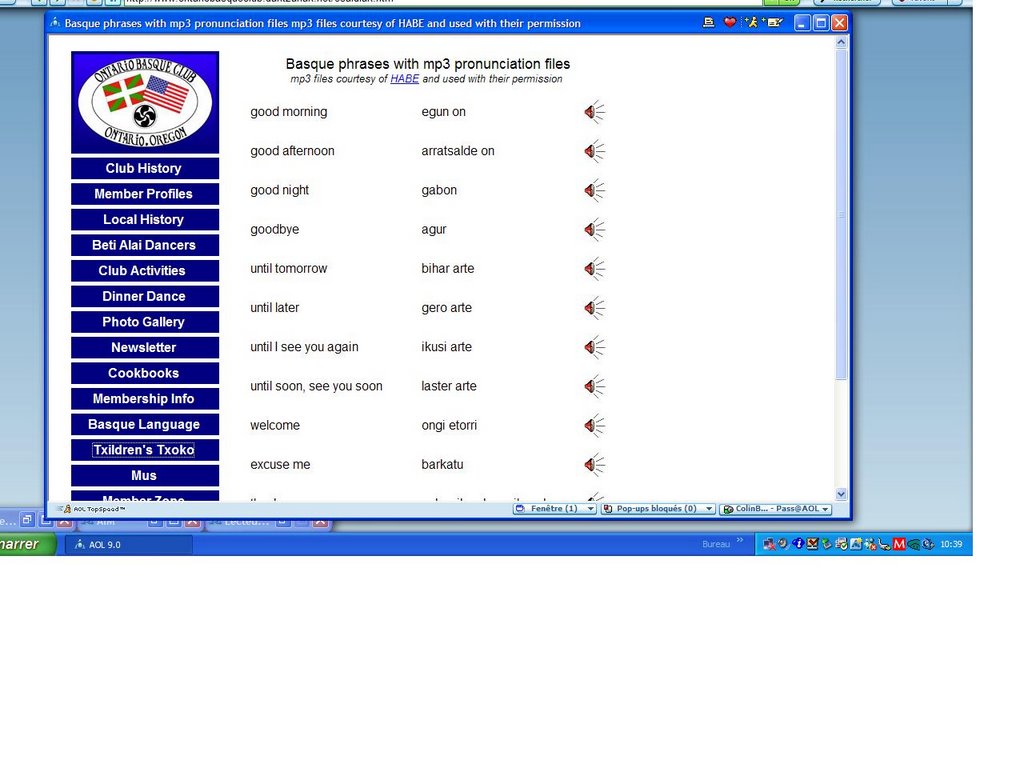
One simply clicks on the loudspeakers to hear the phrases.
The sounds you hear are reasonably close to the spellings, which might make you think the language would be easy to learn. But do not be deceived? It is, we are told, a devilishly difficult language to master, certainly if you are aiming for fluency. Why is that ?
Wikipedia lists its "peculiarities". Without labouring them, here, in green, is a sample of what awaits you :
Basque is an ergative-absolutive language. The subject of an intransitive verb is in the absolutive case (which is unmarked), and the same case is used for the direct object of a transitive verb. The subject of the transitive verb (that is, the agent) is marked differently, with the ergative case (shown by the suffix -k). This also triggers main and auxiliary verbal agreement.
The auxiliary verb which accompanies most main verbs agrees not only with the subject, but with the direct object and the indirect object, if present. Among European languages, this polypersonal system (multiple verb agreement) is only found in Basque and some Caucasian languages. The ergative-absolutive alignment is also unique among European languages, and rather rare worldwide.
Consider the phrase:
Martinek egunkariak erosten dizkit.
"Martin buys the newspapers for me."
Martin-ek is the agent (transitive subject), so it is marked with the ergative case ending -k (with an epenthetic -e-). Egunkariak has an -ak ending which marks plural object (plural absolutive, direct object case). The verb is erosten dizkit, in which erosten is a kind of gerund ("buying") and the auxiliary dizkit indicates:
di- marks a verb with the equivalent of both a direct and an indirect object, in the present tense;
-zki- marks the equivalent of a plural direct object (in this case the newspapers; if it were singular there would be no infix); and
-t is the equivalent of the indirect object mark: "to/for me".
in this instance an unmarked or "null case" equates to the "nork", which in most European languages would be the subject.
The phrase:
"you buy the newspapers for me" would translate as:
Zuek egunkariak erosten dizkidazue
The auxiliary verb is composed as di-zki-da-zue
(equivalent terms in European languages)
di- = direct object
-zki- = marks plural of direct object
-da- = indirect object (to/for me) {-t becomes -da- when intercalated.}
-zue = subject (you pl.)
A Basque noun is inflected in 17 different ways for case, multiplied by 4 ways for its definiteness and number. These first 68 forms are further modified based on other parts of the sentence, which in turn are inflected for the noun again. It's been estimated that at two levels of recursion, a Basque noun may have 458,683 inflected forms (Agirre et al, 1992).
Ouch ! One wonders if the first prehistoric Basque "Founding Fathers" who set sail for Britain all those thousands of years ago were perhaps fleeing linguistic persecution. And the first decision on arrival in Cornwall or wherever would have been to name the rocky headland a cliff if there was just one, or cliffs if more than one, and leave it at that. Freedom !
What is the evidence for Basque being an ancient language ? Very little direct evidence, unsurprising since it was not written down before the 16 th century. No ancient stone tablets.
ed: the above sentence was drafted a few day ago, but I have just this minute chanced upon a recent update to Wikipedia, that now contradicts it.
In June 2006, archaeologists at the site of Iruña-Veleia discovered an epigraphic set with a series of 270 Basque inscriptions and drawings from the third century. [1] Some of the words and phrases found were "urdin" (blue), "zuri" (white), "gori" (red), "edan" (drink) "ian" (eat), "lo" (sleep), "Iesus, Iose ata ta Mirian ama" (Jesus, the father Joseph and the mother Mary), and "Geure ata zutan" (May the Father be with you). This discovery shows once again that the basque language is a very stable one.
Well now, we learn new things all the time !
And here's something interesting: the Basque words for axe and knife are closely related to that of stone. Scholars believe that those words were coined thousands of years ago, in the Stone Age era. Put another way, and with no pejorative overtones whatsoever, Basque appears to be a Stone Age language, albeit one that has evolved, and has imported and adopted many foreign words from Latin etc.
A sizeable number of Basques emigrated to the United States during the 19th century. Many were initially attracted to the gold mines, but often defaulted, so to speak, to sheep farming, with which they were more at home.
I have yet to read Stephen Oppenheimer's book. I will be interested to see how he addresses the issue of the English language, given we are descendants of early Basques.
However, it would be wrong to suppose that an immigrant group, finding itself in new territory, separated from their native homeland by hundreds of miles of ocean, and surrounded by new neighbours, should retain their own language.
There are strong incentives, in fact, to adopt that of their neighbours, their new trading partners ( or possibly old ones!). This is what the Normans did. They were originally Norsemen, as the name indicates, who migrated south into present day France, and who quickly, within the space of a few generations went so completely native that, by the time of the Norman invasion, it was a 11th century form of French they introduced into England, subsequently to be called Anglo-Norman.
But despite this Conquest, and some intermarriage with the locals (or the more predatory droit de seigneur if you recall a particularly ugly scene in Braveheart), the Normans and other invaders have left very little evidence in the genetic record. Clearly our Brit ancestors were very fussy about whom they would let their daughters marry ! I mean to say, blacksmith John, would you let your daughter marry one of those frenchified Normans ?
So why don't we still have the odd word or two of Basque origin in English ? In fact there is one – "bizarre" - which seems appropriate, although it's a late arrival.
Oh, and did you know that Arizona is from Basque, meaning "good wood " ? Nope, I didn't think you did. Nor did I until quite recently (yesterday) .