Note from Colin (hippo's keeper) added Saturday Nov 18th
It seemed like a good idea at the time: to let the inner nerd speak. He needs his occasional day out, same as the rest of us. But to spare you having to plough through his leaden prose (in autumnal chesnut below ) here's the gist of his message.
"Anglo-Saxon" has numerous connotations, none of them flattering.
It implies:
(a) a barbarian war-like disposition
(b) the idea that the English are outsiders, not indigeneous to Britain
(c) The English-dominated government in London has no mandate to speak on behalf of the whole of Britain
(d) the English are genetically of mixed blood and, ipso facto, unknown, untrustworthy quantities
(e) the English are too given to acting as poodle to those other "Anglo-Saxons", namely the Americans.
So when you refer to us, Frère Jacques, as "les Anglo-Saxons", don't expect us to share your little Gallic joke. What joke ? Where's the humour ? Whatever happened to the Entente Cordiale ? 
Well, you do disappoint me, boys and girls. Only one response to my questionnaire so far, and that from the boy who always has his hand up.
Now if he is capable of an original "take" on the expression "Anglo-Saxon" , as used by the French to refer to ourselves, then I'm sure YOU too could come up with something original if you tried.
Or are you going to let that clever boy do all your thinking for you ?
But here are three more views on what Anglo-Saxon means, outside of its strict historical context.
1. The Anglo-Saxons arrived as foreign interlopers. Even if they had been entirely peaceful, they ended up somewhere they didn't belong. Anglo-Saxons are not true Britons. The true Britons , we used to be told (mistakenly), are the Celts, ie the Scots, Irish and Welsh. Ipso facto, the modern day English are not authentic British, but a foreign strain. They are your worst nightmare, the transient, the traveller, who deciding he likes his new abode ("Good 'ere, innit ?) becomes first a squatter, and then sets up home in your backyard.
And here's a point where I find myself partially in agreement with that solitary commentator: on no account will the French risk offending their Celtic friends and/or ancient allies by speaking disparagingly of the British. Better to avoid that blanket term, and instead speak sniffily of the "Anglo-Saxons". When in doubt, use coded language.
2. The Anglo-Saxons were not peaceable interlopers. Far from it: they were warlike invaders who subjugated the native Britons. "Briton" is in fact an Anglo-Saxon word that means "slave". Ipso facto, the term "Anglo-Saxon" is a reference to our supposed belligerence and bellicosity, still manifest 1500 years later, we are told, in the behaviour of our football hooligans, Margaret Thatcher's re-taking of the Falklands, her taming of the unions, Blair's military campaigns in Kosovo, Afghanistan and Iraq.
3. The Anglo-Saxons were a hybrid entity - a genetic cross. Put crudely, that means the modern English are mongrels. As such they have a unique mix of genes that is peculiar to the English. So when the English appear to think or act differently from mainland Continentals, one should not waste time in trying to reason or understand. They are "Anglo-Saxons" who behave the way they do, because it is hard-wired into their DNA.
*************************************************
So there you have it, class: already we have three distinctly different interpretations, and that's not counting the one we have already. You see, I have made no mention of our transatlantic cousins, the Americans. That's an aspect that appears to weigh heavily in the mind of our single Commentator.
But none of these interpretations, note, are in the least bit flattering. All can be made to sound pejorative.
What a handy expression, then, to have: "Anglo-Saxon" : a multipurpose, coded insult, one that can always be passed off lightly, if challenged, as a cheeky historical allusion, but which really comes down to one thing : the English are NOT ONE OF US.
We Brits are generally an easy going lot. We're not given to getting worked up about the tags, labels, that others apply to us. But can we afford to be so relaxed, philosophical about one that can be taken to mean so many different things ? And one, moreover, that according to Stephen Oppenheimer, reinforces a mistaken view of history and genetics, ie that the English are not native to Britain ?
We warn our own children of the dangers of racial stereotyping which can lead to demonising, then persecution. So why should we acquiesce to the misuse of a label that has ceased to have any meaning in modern society ? Why have we allowed others to lift a geographical term from our British history, that can now be used quite freely in the politest of society as a snide, derogatory NATIONAL PUT-DOWN ?
Showing posts with label Anglo-Saxon. Show all posts
Showing posts with label Anglo-Saxon. Show all posts
Friday, November 17, 2006
So what do YOU make of that term "Anglo-Saxon" ?

Thursday, November 16, 2006
Is "Anglo-Saxon" an impolite term ?
 Here are some questions from my pal hippo for you to ponder on - and to contribute a comment if you feel so inclined.
1. Why do the French refer to us on occasions as Anglo-Saxons ?
2. Who is included in that description - is it just the English, or does it include the Scots, the Welsh and the Northern Irish ?
3. What is the term "Anglo-Saxon" intended to convey that is not adequately described by the term British, English etc ?
4. Is the term Anglo-Saxon intended to be pejorative ? If so, mildly or strongly ?
5. Anglo-Saxons are described in some history books as 'barbarian invaders'. Is the term Anglo-Saxon synonomous with barbarian ?
6. When the French refer to Anglo-Saxon economics, which of the following countries is included: : Britain, Ireland, the USA, Canada, Australia, New Zealand, South Africa ?
7. If it is OK to refer to Britons, or British-derived stock as Anglo-Saxons, would it be equally OK to refer to the French as Franks, Gauls, or Normans ?
Wednesday, November 15, 2006
Re-discovered. Our 'Britannian' heritage
Gradually, little by little, the full implications of Oppenheimer’s obituary to our "Anglo-Saxon" identity sinks in. For those new to this site, look please at two earlier posts on this blog ("Discover your inner Basque" Part1 & Part 2).
To recap, briefly, there's a Professor Stephen Oppenheimer of Oxford University who has painstakingly gathered sophisticated, high-tech genetic data proving that the British are just as indigenous to Britain as the Aborigines are to Australia, or the Inuit to the Arctic. Forget all that nonsense, he says, about Celts being the true Britons, or the English really being “Anglo-Saxons”, relatively new arrivals from the land of the Angles (Denmark) or Saxony on the north German plain.
All of us, he says, English, Scots, Welsh, and even the Irish ( yes the Irish as well, bless their little linen socks ) are for the most part descended from Basque immigrants. It was these hardy folk, Europe’s great survivors, who migrated from their homeland, in the Pyrenees, and who re-populated Britain after the last Ice Age. But it happened so long ago (15,000 years) that Britain was then still part of Continental Europe, joined by a land bridge.
So the new arrivals would have had to make some effort to get on with their new neighbours. At some point these Basque settlers dumped their own language in favour of the local lingua franca (hardly surprising, one might think, looking at the complexity of Basque, at least to our eyes and ears: Basque is like no other language).
In so doing the Basques became 'proto-British', in exactly the same way, many millennia later, a group of Scandinavian settlers in northern France adopted the local language, dropped their own, and in so doing became proto-French. We call them the Normans ( a good name because it alludes to their origins).
Oppenheimer has some other surprises too (while straying away from hard genetics into more contentious areas of linguistics): he believes that English is NOT derived from a 5th century Germanic tongue, brought in by Anglo-Saxon settlers, as we were told at school, but from an earlier Germanic tongue that was established well before the Roman invasion.
So our genes are mainly (typically 80-90%) indigenous, rather than foreign imports. We are not mongrels, Heinz 57 varieties, forced to console ourselves with the thought that what we may lack in ethnic authenticity, in finely groomed pedigree status, we hopefully make up for in hybrid vigour.
Whether we consider ourselves as English, Welsh, Scottish, Irish, we are all “British”. Ah, but meaning what, you may ask ? A second generation Jamaican living in Manchester is British, but is unlikely to have Basque genes, and is indeed very happy with the ones he has got. Whilst not especially enamoured of my first name, I’d have been very happy to have Powell as a surname, all nicely preceded by General, with gold braid, chauffered limousine and salary to match ! Yes, Colin (“Coe-leen”) Powell has a Jamaican Mum and Dad.
So if we want to talk meaningfully about our origins in pre-history - our roots- what we are clearly lacking is a word that is a collective for the indigenous population of the British Isles , ie GB and Ireland (Eire and Ulster) prior to the arrival of more recent immigrants.
But I can't think of one, off the top of my head. So let’s invent one, for the purpose of this exercise, to avoid possible confusion, and likewise to avoid giving offence to the many splendid folk of so-called New Commonwealth origin. Many of them have contributed in numerous ways, large and small, to modern British society.
How about “Basque-British” or simply “Basquish” for starters?
There's one drawback : 15,000 years is a long time to be separated from one's antecedents. A lot of water has flowed under the bridge. Actually, there's quite a lot we share in common - raising sheep, fishing, building ships etc. But the problem has been that language of their's. A lot of Brits have learned to speak Spanish, both Castilian and Catalan. But how many do you know how can speak Basque ? As I say, we've lost contact with our forbears. The linguistic phone went dead a long time ago. We both of us hung up. So few of us will rush precipately into calling ourselves Basquish.
So while we gradually get back on speaking terms, let’s look for a different name for ourselves, enlighted with Oppenheimer's research and scholarship.
There are many folk these days who make no secret of their dissatisfaction with the term "British". I know I do. It’s too vague to mean anything useful. Some have now retreated back to their "footballing" national identity.
To recap, briefly, there's a Professor Stephen Oppenheimer of Oxford University who has painstakingly gathered sophisticated, high-tech genetic data proving that the British are just as indigenous to Britain as the Aborigines are to Australia, or the Inuit to the Arctic. Forget all that nonsense, he says, about Celts being the true Britons, or the English really being “Anglo-Saxons”, relatively new arrivals from the land of the Angles (Denmark) or Saxony on the north German plain.
All of us, he says, English, Scots, Welsh, and even the Irish ( yes the Irish as well, bless their little linen socks ) are for the most part descended from Basque immigrants. It was these hardy folk, Europe’s great survivors, who migrated from their homeland, in the Pyrenees, and who re-populated Britain after the last Ice Age. But it happened so long ago (15,000 years) that Britain was then still part of Continental Europe, joined by a land bridge.
So the new arrivals would have had to make some effort to get on with their new neighbours. At some point these Basque settlers dumped their own language in favour of the local lingua franca (hardly surprising, one might think, looking at the complexity of Basque, at least to our eyes and ears: Basque is like no other language).
In so doing the Basques became 'proto-British', in exactly the same way, many millennia later, a group of Scandinavian settlers in northern France adopted the local language, dropped their own, and in so doing became proto-French. We call them the Normans ( a good name because it alludes to their origins).
Oppenheimer has some other surprises too (while straying away from hard genetics into more contentious areas of linguistics): he believes that English is NOT derived from a 5th century Germanic tongue, brought in by Anglo-Saxon settlers, as we were told at school, but from an earlier Germanic tongue that was established well before the Roman invasion.
So our genes are mainly (typically 80-90%) indigenous, rather than foreign imports. We are not mongrels, Heinz 57 varieties, forced to console ourselves with the thought that what we may lack in ethnic authenticity, in finely groomed pedigree status, we hopefully make up for in hybrid vigour.
Whether we consider ourselves as English, Welsh, Scottish, Irish, we are all “British”. Ah, but meaning what, you may ask ? A second generation Jamaican living in Manchester is British, but is unlikely to have Basque genes, and is indeed very happy with the ones he has got. Whilst not especially enamoured of my first name, I’d have been very happy to have Powell as a surname, all nicely preceded by General, with gold braid, chauffered limousine and salary to match ! Yes, Colin (“Coe-leen”) Powell has a Jamaican Mum and Dad.
So if we want to talk meaningfully about our origins in pre-history - our roots- what we are clearly lacking is a word that is a collective for the indigenous population of the British Isles , ie GB and Ireland (Eire and Ulster) prior to the arrival of more recent immigrants.
But I can't think of one, off the top of my head. So let’s invent one, for the purpose of this exercise, to avoid possible confusion, and likewise to avoid giving offence to the many splendid folk of so-called New Commonwealth origin. Many of them have contributed in numerous ways, large and small, to modern British society.
How about “Basque-British” or simply “Basquish” for starters?
There's one drawback : 15,000 years is a long time to be separated from one's antecedents. A lot of water has flowed under the bridge. Actually, there's quite a lot we share in common - raising sheep, fishing, building ships etc. But the problem has been that language of their's. A lot of Brits have learned to speak Spanish, both Castilian and Catalan. But how many do you know how can speak Basque ? As I say, we've lost contact with our forbears. The linguistic phone went dead a long time ago. We both of us hung up. So few of us will rush precipately into calling ourselves Basquish.
So while we gradually get back on speaking terms, let’s look for a different name for ourselves, enlighted with Oppenheimer's research and scholarship.
There are many folk these days who make no secret of their dissatisfaction with the term "British". I know I do. It’s too vague to mean anything useful. Some have now retreated back to their "footballing" national identity.
That’s been true of the proud Scots and other minority nations for a long time. More recently, the English have begun describing themselves as such, ie English, and rediscovering the Cross of St. George, and places to hang it on their windowsills.
Some of this resurgence of nationalism has been spurred on by Scottish devolution, the unresolved Lothian question, and the fact that your Scottish aunt gets better treatment north of the border from the so-called NHS. Many of us, then, view the retreat into, say Englishness, from Britishness, with some regret, and with a degree of suspicion that with it may come a hidden, rabidly right-wing political agenda.
And there are those of us who, while ready to dump "British" as an outdated label, regret seeming to distance ourselves from our fellow members of the United Kingdom. There's a sense of having thrown out the baby with the bath water.
Here’s a suggestion. The Romans had a
Here’s a suggestion. The Romans had a
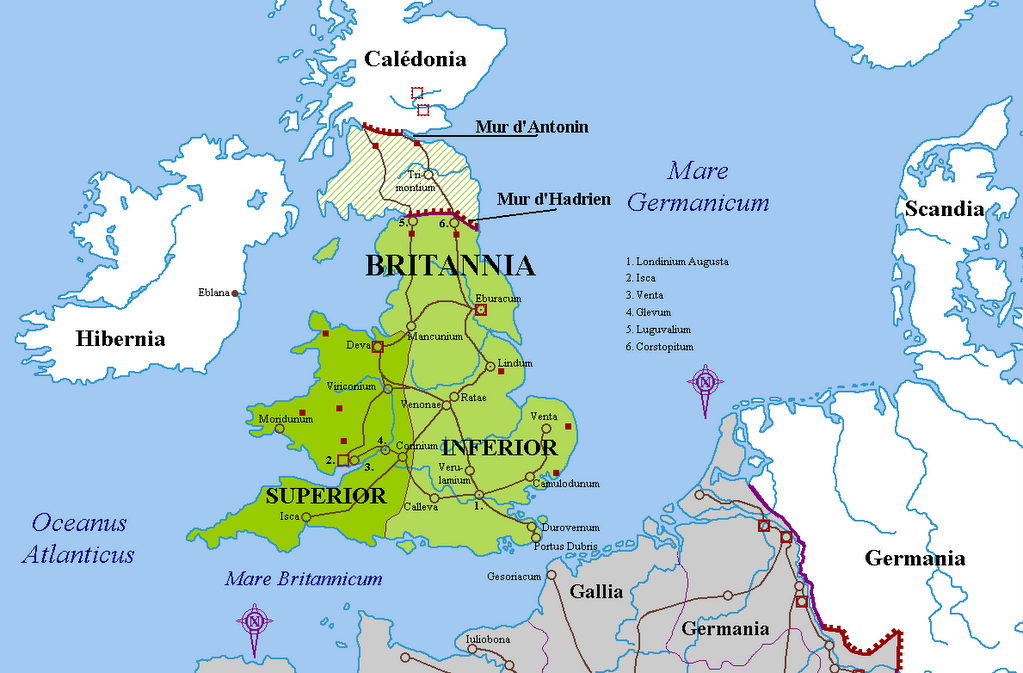
name for the island that we call Great
Britain. They called it Britannia. And what
did the Romans ever do for us, apart from giving us a regal-sounding name ?
Well, as you see, they put us on their map of the known world. And that was just for starters.
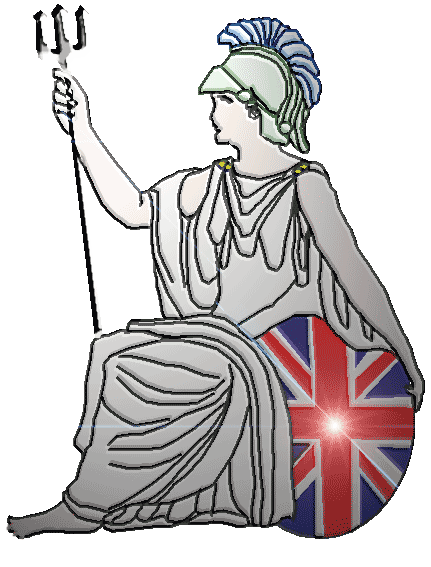
So why don’t we, descended from the original inhabitants of Great Britain, nay the entire British isles, who are possessed largely of aboriginal genes, so we are told, start calling ourselves Britannians ?
Why ? It's the heritage thing, stupid. It's so as to stop feeling as if we were Johnny-Come -Lately's. Like Tartars off the Central European steppe. And it would provide a welcome, re-invigorated reconnection with our national icon Britannia who graces our coins, and some of our stamps.
And there are one or two fine statues of that charismatic lady (Maggie Thatcher Mark 1 ?) in London and elsewhere. Or am I thinking of Boadicea ? Never mind, the two look a bit similar, chiselled features an' all and no one ever questions the British credentials of that warrior queen. It was, after all, she who anticipated James Bond's inventive pal Q in the axle-mounted blade department by about 2000 years, putting the Romans to flight. Well, for a while, at any rate.
So that's the problem sorted then, as far as the English, Scots and Welsh are concerned. Oh yes, and the Cornish.
But that leaves the problem what to call the Irish ? Oh dear, there's just no escaping that Irish Question.
Well, one thing's for certain. The inhabitants of the Irish Republic (Eire) will probably not be rushing to celebrate their genetic kinship with us Brits, so are not a problem.
The difficulty as ever, is with those folk in the north, they of the Scottish antecedents, we are told. Although before that I understand they were Irish, like, you know, Irish Irish. (It’s all so complicated ! ).
But that leaves the problem what to call the Irish ? Oh dear, there's just no escaping that Irish Question.
Well, one thing's for certain. The inhabitants of the Irish Republic (Eire) will probably not be rushing to celebrate their genetic kinship with us Brits, so are not a problem.
The difficulty as ever, is with those folk in the north, they of the Scottish antecedents, we are told. Although before that I understand they were Irish, like, you know, Irish Irish. (It’s all so complicated ! ).
The Irish may not be Britannian, in the Roman sense of the word, but let's not get hung up on Latin semantics: if the Irish want to be called the same as us, then let them (just as they presently call themselves British, despite there being a touch of geopolitical licence there).
The Romans called the island of Ireland “Hibernia”. By this reckoning, the Rev Ian Paisley could be described as “Hiberno-Britannian”. I'm sure he's had some less flattering descriptions in his time. But in the event that even he, with his formidable tongue, might find "Hiberno-Britannian" too much of a mouthful, he might prefer to go on calling himself an Ulsterman, or just plain British (on the assumption that he won't be confused with the Paisleys who divide their time between Brixton and Kingston. Kingston, Jamaica that is).
All this semantic ground-work is in preparation for tomorrow’s post. It’s to placate a little fellow who’s been crashing around on a certain hippo- campus for days, staging endless protests, sit-ins, waving placards, having tantrums, demanding instant solutions, immediate redress.
The Romans called the island of Ireland “Hibernia”. By this reckoning, the Rev Ian Paisley could be described as “Hiberno-Britannian”. I'm sure he's had some less flattering descriptions in his time. But in the event that even he, with his formidable tongue, might find "Hiberno-Britannian" too much of a mouthful, he might prefer to go on calling himself an Ulsterman, or just plain British (on the assumption that he won't be confused with the Paisleys who divide their time between Brixton and Kingston. Kingston, Jamaica that is).
All this semantic ground-work is in preparation for tomorrow’s post. It’s to placate a little fellow who’s been crashing around on a certain hippo- campus for days, staging endless protests, sit-ins, waving placards, having tantrums, demanding instant solutions, immediate redress.
I'm now a model of composure, I'll have you know.
So what’s got hippo so worked up ? Well, I'll tell you. It began with his reading about Stephen Oppenheimer. And it progressed from there. And it's all come to be focused on one little word. Correction: two hyphenated words. It’s that term that the French have for us, whenever the subject of economic and social policy differences arise, which is like – every day. You’ve guessed it. Anglo-Saxon.
So what’s got hippo so worked up ? Well, I'll tell you. It began with his reading about Stephen Oppenheimer. And it progressed from there. And it's all come to be focused on one little word. Correction: two hyphenated words. It’s that term that the French have for us, whenever the subject of economic and social policy differences arise, which is like – every day. You’ve guessed it. Anglo-Saxon.
Yes, hippo demands action and redress. And if he doesn’t get it, then you know what ? He’ll start to retaliate in kind, by referring to the French* as, guess what ? Normans !
Read what hippo has to say tomorrow, dear friends.
*Well, the northern ones at least. Not my antiboulenc* next-door neighbours, perish the thought. Some of our best friends (now) are French.
Antiboulenc, in case you were wondering, is the old Provencal word meaning “belonging or pertaining to Antibes” . My wife is active in the Antiboulenc Society. The modern rendering is Antibois, a term I avoid. Can’t risk having the party hostess think I’m teetotal.
Subscribe to:
Posts (Atom)