Showing posts with label Antibes. Show all posts

Saturday, July 21, 2007

More on the Colossus of Antibes aka the Nomade by Jaume Plensa

Jaume Plensa's "Nomade" at its "unveiling" (vernissage) on the ramparts of Antibes' Bastion St-Jaume, yesterday, Friday July 20th 2007


Art and Culture

If you have just arrived at Dreams and Daemons from a different site, please be advised that this post is a postscript to the preceding one, entitled Jaume Plensa does Antibes proud with his alphabetical Nomade.

This one is intended as a supplementary archive, with some more photographs and with biographical information on the artist and his previous works. You may well have encountered some of the artist's work in public places before, perhaps without being aware of it, eg. the new Toronto international airport.


That's the artist at the microphone in the pale suit
('point and click' to enlarge, same as other pix)

With him on his left is Jean Leonetti, Député Maire in the darker suit.
(word of caution for non-expatriate Brits: M.Leonetti is not a deputy Mayor, but combines the duties of MP (Député) in the French national parliament, and that of Maire (Mayor) of Antibes here in his local power base. One has to be careful to get that sort of thing right, bloggers included: town mayors are very important people here in France)


Here was the view from the hospitality area
Viewing at the vernissage was by invitation only. I wangled an invitation through being married to Jane, who is secretary of the Antiboulenc Association (Antibes' main cultural/artistic society which runs its own library in the Vielle Ville).


View from inside the Nomade, looking roughly south


That's one of Antibes two iconic Saracen towers you can see through the loop of the J, with the northern end of the Cap d'Antibes visible behind the X.


Recent demolition and partial restoration of the Bastion St. Jaume
When we first came to Antibes some 6 years ago, the port area where the Nomade stands was a bit of a sad sight to behold. It had once been a busy site for naval fitting out, under the name Chantier Navale, but the buildings were derelict and unsafe, being closed off to the public. The Antibes town council decided on a drastic remedy which involved demolishing everything except the remaining sections of sound stonework. It now looks somewhat bare and skeletal, but offers new vantage points for townsfolk and tourists. The port area needed something to act as a focal point, a role which the Nomade serves admirably. It's supposed to be a temporary implantation in Antibes, but given that its paintwork is weather -resistant (well, that's what it says on the plinth), how nice it would be if it could become a permanent feature : the Colossus of Antibes (?).
Links: The first is from the University of Massachusetts website with the following summary of the artist:

Plensa integrates a wide variety of materials such as iron, glass, bronze and resin to take best advantage of the more intangible qualities of light and sound as well as the ideas that arise from spoken or written texts.
His main preoccupation is with the body and the manner in which we perceive our world from the purely sensory to more complicated thoughts, gestures, and expressions. It is his realization of this participatory mode--an always present, primal interaction between perceiver and perceived--that underlies all of his work, no matter the shape it assumes.
Second link: photographs and background info on the artist's work on permanent public display at Jacksonville, Florida and Toronto.
Third link: see the official Antibes-Juan-les-Pins website (French language) for info' on the public works programme at the Bastion St-Jaume - and the flagging up of the Nomade.

Jaume Plensa does Antibes proud with his alphabetical Nomade


Art and culture


Yesterday evening Jane and I attended the "unveiling" (more correctly, vernissage) of Nomade by Jaume Plensa, that accomplished Spanish master of plastic arts.

Incidentally, that word plastic should be taken in its French meaning for 3-dimensional art (sculpture etc) irrespective of materials.

Nomade is breathtaking in its form, simplicity and perhaps symbolism, given its beguiling lattice work consisting of nothing but letters of the alphabet.

How did he manage , I keep asking myself, to create that continuous smooth, curving surface, with an intriguing broken edge at the jawline.

What, if anything, did he use as formwork ? I'll add still photographs later during the day that will knock your socks off ! Second thoughts: here's a taster, viewed from inside, looking back towards the Old Town.

Monday, July 16, 2007

My flashy next door neighbour called Juan-les-Pins


One of the main drags in the centre of Juan-les-Pins

Living in France


Feeling jaded ? Want to show you can still strut your stuff with the best of them ? Inner man or woman in need of a pep ?

The place for you in my part of the world is Juan-les-Pins. It’s Antibes' next door neighbour, but the two places are chalk and cheese. They could be 50 miles apart to judge on scenery, and light years apart in temperament.

Antibes is first and foremost an ancient fortified port. Traditionally austere, it then discovered that narrow back alleys attract tourists in droves if filled with cafés, boutiques, bars etc.

But Antibes faces east, with only a few privileged places catching the sun in the late afternoon and evening, and there’s a dearth of places where one can wine and dine with a sea view. Most serious drinking of an evening is done on the Boulevard d’Aguillon, which has the monumental Courtine blocking the view of the harbour, save for the odd archway or two.

Juan-les-Pins in contrast is a purpose-built modern resort, founded in the early 20th century on a sweeping pine-backed bay that faces south. It is first and foremost a destination for sun-worshippers, in which private enterprise has bagged the most accessible stretches of sand for beach clubs and restaurants.
There's a curious feature about the way the place has developed: although there is no shortage of restaurants along the promenade, with their stunning views of the Esterel massif to the west, there are relatively few bars . Those wishing merely to have a drink find themselves funnelled into the relatively small area with a concentration of glitzy boutiques, neon lights, ornamental palms, ice cream parlours, with the Casino luring in free-spending punters with flashy cars to match.


Beach club restaurant. The leaning palm a warning of things to come ?

(according to this week's Sunday Times global warming may soon be bringing hurricanes to the Mediterranean !)


There are the inevitable Brazilian acrobats, doing their amazing somersaults on hard unforgiving asphalt, the street traders and beggars. Kittens are popular this year with the latter, no doubt to attract silver from the pockets of parents with small children or from kind-hearted old ladies.

There was a sprinkling of hookers, looking appraisingly at unaccompanied males (except me with my camera), probably pickpockets and drug dealers (the downside of Juan in the season) and a very visible police presence, including the CRS heavies.

Juan-les-Pins is a place we visit once, maybe twice a year of a summer’s evening, generally when there’s the added attraction of a firework display, as was the case last Saturday on Bastille Day.
Juan-les-Pins, you see, is a frontal assault on the senses, but not somewhere I'd wish to be for a week. It’s that crush of humanity, with inevitable loss of personal space that hits one, and the strange intensity and impersonality. Despite sitting cheek by jowl in the crowded street bars, strangers rarely talk to each other once the sun sets.


Another beach club restaurant, looking west towards Golfe Juan


The fireworks were splendid. We saw new ones we've never seen before. There were some that created lacy orange sprays in the sky and sea level, reminiscent of weeping willow trees. There were others which pulsed in red strobe-like flashes on the way down, and others which ended as incandescent flares floating on the sea, like theatre footlights.

I didn’t have my camera . Who takes a camera to Juan after dark except to take pictures of friends across the table. ? One goes to Juan to revel, not record for posterity.

So I returned last night alone, sat at the same bar, walked the same lanes and promenade, taking pictures without a flash, which explains why they are in some cases an impressionist blur.

Make sure you have your speakers activated when you play the YouTube clip which I took outside the place called Pam Pam, with the vocalists and band inside pushing decibels aplenty out into the street.


There's a street with two ice cream parlours, with just a shop separating the two. If you like rum and raisin, avoid the one that claims to be Italian – its offering tastes of neither rum nor raisin. In fact it tastes of nothing at all.


Ice cream parlour (I'll try this one first next time in preference to its neighbour)


If you have a few hours at your disposal, book a table for dinner at one of the beach restaurants eg Juanita, and watch the sun go down behind the jagged Esterel, the far side of Cannes, with a candle on the table. Magic ! But smear yourself well, especially ankles, to protect against things that bite in the night.

Cute to look at, perhaps, but not electric: has a rasping little two stroke engine


The main casino

Links Pam Pam

Friday, April 06, 2007

Jane's guest blog - Antiboulenc Association


Antibes (Port Vauban and Vieille Ville) viewed from Fort Carré
(point and click to enlarge)
*
*
Today's post is from my better half Jane, writing in her capacity as Secretary of our local Antiboulenc Association of which we have been members now for the best part of four years.
Aunty what ? Well, I'll let her explain.


The Antiboulenc Association was founded more than 40 years ago by a local lady, interested in the history of Antibes. The adjective "antiboulenc" is the medieval form of the modern "antibois" and comes from the original name of the town - Antipolis. It was originally thought that "the place opposite", which is what Antipolis means, referred to the town opposite Nice on the other side of the Baie des Anges. There is another theory that it meant the place opposite Corsica, because the currents brought ships in that direction.

The association started out with a library and over time various other activities were added, such as a film club and art groups. We now have two centres: the library (http://www.biblioantiboulenc.cjb.net/) and premises on the rue de la Tourraque, also in the old town, where the various groups such as water-colour painting, sculpture, ceramics meet.
All the groups are run by volunteers, who have expertise in the different spheres. We are a non-profit-making organisation and one of the original aims was to welcome strangers who had come to live in Antibes, rather as the Accueil des Villes Françaises does now.
The membership is mainly French, but there are also Italians, Belgians, Scandinavians, Brazilians and Britons. One of the most popular groups is that for conversation in French for foreigners. There are also classes and conversation groups in English and Italian.

One of my jobs as secretary is to organise our various evening parties.
The Beaujolais evening and the Carnival evening are annual events and we try to add as many different themed parties as possible.
Last month we had a Soirée Exotique, with rum and punch rather than wine, and in May we are holding a European evening to celebrate Europe Day and the fact that the secretary and her two assistants are all non-French, ie British, Italian and Belgian.
For this everyone attending will be asked to provide a dish from one of the member states of the EU and the wine choice will reflect this diversity as far as possible. The picnic at the end of June, in some local beauty-spot, such as Cabris or Gourdon, marks the end of the year's activities, with everyone bringing goodies to share round.

A couple of years ago, when I was assistant secretary, I organised a fairly riotous Scottish evening.


Make sure your speakers are switched on, then just point and click to start video

With the kind assistance of the Loch Fyne group a buffet of Scottish delicacies was provided.
My mother's recipe book came in handy too. The Drambuie went down well but for some reason the Irn Bru was less popular! Even the haggis was well-received. And Andy Stewart provided the background music. Long live the Auld Alliance!


Two recent day trips this year have been to the offices of the local paper Nice-Matin and to the air force base at Mont Agel behind Monaco.
Mont Agel was the last fort of the Maginot line and is now one of France's air-defence posts, keeping a watchful eye on the skies above the Mediterranean.
The next outing planned is a four-day trip to Northern Italy to visit places of historical interest as well as galleries. Past journeys have been to Barcelona and Genoa, when that was the European city of culture. The interests of the Antiboulenc Association are not just local.

Speakers are regularly invited to give talks on subjects ranging from the paintings of Cézanne to the military harbour of Villefranche.
This year marks anniversaries of the Greek writer Kazantzaki, who spent the last years of his life in Antibes, and of the celebrated military architect Vauban. We will be paying tribute to both of them.
Our website at http://www.antiboulenc.com/ gives details of the current month's events such as the videos to be shown and the book choice of the reading group, as well as notice of future activities.
Update: Sunday 8th April: Received the following message from Jackie (and faithful companion, cocker-springer Loui):
"Not had time to write but I loved your little video of the Scottish evening!!

I did go to your web site for the Antiboulenc Association and decided that me dechiperhing the text (with my very poor French!) after having a brandy or two wasn't ideal so will go back and read it tomorrow!

Do you celebrate Easter in France still??"
Hello again Jackie. Glad to hear your weather's good for the Bank Holiday (most unBritish!!).
The Malaysian Grand Prix is about to start - we'll be back with an answer about the French way of celebrating Easter later.
Grand Prix over: Fernando Alonso , last year's champion was the winner. Jane is a keen follower of Formula 1, and has taken me to Silverstone and (last year) to Monza, and took G to see the Monaco Grand Prix. We have seats booked for Spa in Belgium in September. Jane has been asked to do her second guest blog next weekend, to coincide with the Bahrain Grand Prix.
Here's her reply to your question, Jackie, about how the French celebrate Easter:
"Yes, Jackie, Easter is celebrated in France as in Britain, although Good Friday is not a "jour férié" (Bank Holiday), which surprises me in a Catholic country.
Bakers and sweet shops are full of chocolate Easter eggs, rabbits, chickens and even some odd additions. Ever heard of Easter lions or scottie dogs?

Many restaurants have a special Easter menu today. We had lunch with friends and enjoyed the 5-course set menu with a main dish of lamb, of course.
Update Sunday 11:50pm
"Hi Colin and Jane

Nope, never heard of Easter lions or even Easter Scottie dogs but there's always a first time for everything! Then again, my rule of thumb is, if it's chocolate, eat it!

Have a great weekend!

J x
And you Jackie !
Comments welcome. Emails to: sciencebod01@aol.com

Saturday, January 20, 2007

Those special relationships


Here's a picture of one of the recent additions to the seafront-furniture at Antibes.

ed: for full screen enlargement, just "point and click" on the photo

It really speaks for itself. It's a weather-resistant reproduction of a painting by Jean-Louis Ernest Meissonier , dated 1868. The plaque (see close-up below) reads "Antibes, la promenade à cheval, l'artiste et son fils Charles.

How's that, then, for a self-portrait ? To put yourself in centre picture, astride a horse, and then to fit in two family members as well . Yes, two: his son, who's also mounted, and his pet dog, by the looks of it, leading the way . It could be someone else's dog, I suppose. Or a private family joke !


But from a casual tourist perspective, the genius is in the siting of the picture. Not only is Antibes' fortified headland in the background, with those two iconic Saracen towers, but the picture is sited at or very close to where the artist must have sat when he painted it. Even for a first time visitor, it's fascinating to do a before -and- after comparison.

For local residents like ourselves, there's the extra interest from seeing precisely what used to be there, before most of the ramparts were knocked down in the late 19th century. It was felt, probably correctly, that Vauban's fortifications were a noose around the town, acting as a stranglehold on development.

It's fascinating to think that when it was painted, some 138 years ago, the hills behind Gourdon and Grasse were visible. They are now blanked out by the 20th century apartment blocks.

Sometimes pictures that I post to this blog enlarge when one "points and clicks" . Sometimes they don't, and I haven't yet figured out why. If this one enlarges (and I can't tell until I hit the Publish key) then you'll probably find that with this one, there's a real sense of being there.

ed: Glory be, the first one does indeed enlarge ! But not the second. Weird ..... But the second was dragged and dropped. Maybe that's the explanation .... Any ideas, you Blogger techies ?

That's despite the non-designer clothing etc. Some artists just have that knack, would you not agree, of making their pictures forever fresh and immediate ?

There are now at least 5 (and allegedly 6) of these repro' art features in Antibes. There's another just a few feet away which is by Claude Monet (1888, Antibes, effet d'après midi) , and almost identical to the one in my margin display, and from the same series.


Others include the charming and whimsical Raymond Peynet (1985, Les Amoureux aux Remparts), again, strategically sited to reproduce the artist's vantage point, with his behatted delicate-looking shoulder-length hair hero and bride in the foreground. His work, which is perhaps a little dated now ( that clothing again) is displayed in a dedicated museum in the centre of Antibes). And there's a pure town/seascape by Eugène Boudin, 1893, Le Port d'Antibes.

Further along, near where the pétanque is played, there's another by Henri-Edmond Cross , 1908, in pointilliste style, called simply Antibes . I used to be a dab hand myself (literally) in that genre, when marker pens first appeared on the shelves at WH Smith, but my work from that era, done during long and often boring biochemistry lectures, has now been sadly and irrevocably lost.

For the reasons mentioned earlier, I shall hold back from posting all the pictures now. If the present ones "enlarge on demand" then I'll try cautiously adding others later.

All are of the same design: enamelled (?) on to a sturdy lava base. Or maybe the artwork is a modern baked resin. Irrespective, one just hopes it will be spared the attentions of the spray-can vandals, whose handiwork is visible on the neighbouring public safety notices etc. How I wish the media would drop the term "graffiti artist". Anyone who blights the environment does not deserve to be dignified by the term "artist".


How good it is to see this civic pride, in what is admittedly an exceptional location that has captivated artists and vistitors alike for centuries. If Antibes can't get it right, who can ?


One of the things I like about France is the way in which art is integrated into everyday life. One sees it so many different ways - street furniture, such as lamps, fencing, barriers, things that in Britain would be seen as utilitarian, and done in the cheapest way possible.

It's the small details that make all the difference - bevelling an edge here, decorative perforation there, angling instead of boring right angles, out-of-plane alignment of slats, hexagonal setts in retaining walls, and so it goes on. Loving detail, and realization that there's more to life than keeping proletarian noses pressed against grindstones. even if that does ensure a continuing flow of billions into Treasury coffers, occasionally to be spent wisely, but as often as not, squandered upon one misguided pet project after another .

Note a touch of disillusionement with UK politics creeping in there. Beware, there's more of that to come. It 's possibly the imminent coronation of Gordon Brown which has a lot to do with it. I made my views on the brooding hermit of No.11 a while ago in a submission to the Times's debate

I used to think he ought to get out more. Well, now he's out, in Africa, India, promising to underwrite their education and infrastructure problems with UK taxpayers' money.
One hesitates to remind Gordon that charity begins at home. But his munificence with our money will sooner or later rebound on him. How long before we hear the inevitable charges of neocolonialism again ?

Visiting my old haunts in the Home Counties there's a roundabout that's been planted out, but the whole effect is destroyed by a collection of hurdle-like, foot-high advertising signs. They were installed presumably at the behest of the local insurance firm that paid for the so-called enhancement. But why be so crass as to advertise their sponsorship in situ, largely counterproductive in terms of aesthetics ? And why use private money anyway for something so public ? Just to save a miserable fraction of a penny on the rates when vast amounts disappear elsewhere into blackholes, (eg like my index-linked public service pension ) ?

Heathrow Airport is not Britain's greatest national asset, but at least it used to greet one, with a sign over that tunnel entrance (next to where the Concorde mock-up is parked) . The sign "Welcome to Heathrow Airport" disappeared sometime in the aftermath of the Thatcher era, and is now replaced with some smug self-satisfied advertising, again, for some financial services company, like Quickfleece and Partners (Bishopsgate).

Driving up the M1 over Christmas , it was depressing to pass under the same old concrete bridges that were there in my student days, en route to Birmingham on that pre-Honda but nevertheless nippy, BSA motorbike. Except those bridges used to be fresh grey concrete, not pretty, but at least new-looking . Now they are dirty yellow-grey, reminiscent of those wartime pillboxes, some with graffiti old and new. Those mean, penny-pinching bridges, totally devoid of grace or style (unlike the later ones on the M6) , just add to the monotony of having to grind up and down that dreary stretch of highway.

So why don't they replace them ? Where does all the taxpayers' money go, apart from the obvious, like machine-gunning Afghans in their own country. Oh, but one musn't be cynical : you see, they are the wrong kind of Afghans. They're the ones of a traditional mindset who have yet to grasp the subtleties of the western democratic process, like having to be governed by someone you didn't vote for.

But we don't normally go into countries that have what is now referred to in media-talk as an "insurgency campaign" . But this one is special : it's to do with GWB's misdirected and ruinously expensive War on Terror. And it goes without saying that we're expected immediately to spring to America's side. A post-9/11 loyalty test , to stand four square with America, Stars and Stripes fluttering, in her hour, correction, decade (or maybe century ?) of need, because we owe the Americans for coming in on our side in WW2 .

Well, yes, but only after the fall of France and the Low Countries. And only after the Dunkirk evacuation. And only after the Blitz and the Battle of Britain. In fact they waited until after Pearl Harbor, and Japan and Germany's formal declarations of war on the USA. That's when our so-called natural allies suddenly remembered that "special relationship" (if you'll excuse the anachronism, given that the term was not coined until Churchill's post war Fulton speech) .

So Britain became America's springboard for Europe. A kind of offshore aircraft carrier. How convenient. And kindly Uncle Sam gave us long -term loans that allowed us to spread the cost of Anglo-American victory over 60 years (the last instalment having just been paid). No wonder my father had to decline even a few weeks of ruinously expensive home-help in 1951, immediately after my mother died, and my grandmother was subsequently robbed of her retirement. And (back to topic) having to settle for those cheap and nasty bridges on the M1 in 1959.

Special relationship ? The only thing special about it is that we're supposed to be feel privileged and honoured having these back-slapping, arm-twisting , gold-reserve gobbling, long term loan shark -providing , other folks' future-mortgaging cousins as our friends and allies.

Frankly I don't care who wins the next Presidential election. The so-called special relationship will remain what it has always been: a marriage of convenience. America's convenience.

Just think, if we weren't so dewy eyed about the special relationship, we could pull a few battalions out of Afghanistan, and replace all those M1 bridges, and allow the Afghans to decide their own destiny by their own means, even if it meant having the" wrong bunch" in power from time to time.

But from an admittedly hard-nosed military perspective, isn't it a lot easier to let the wrong bunch in, and then target that country's military, all conveniently ensconced in their cosy barracks, than to deal with hit-and-run insurgents, sleeping rough under the stars ?

As for that lost cause called Iraq , well, I just hope the roofs of the US and UK embassies are strong enough to take those helicopters, needed for Saigon style evacuations when the time comes.


Here and there, along the M1, there's been some belated planting of saplings , presumably areas deemed to be environmentally sensitive for one reason or another. It'll be years before a softening effect is achieved, but it will be worth it when it comes. Why is this not more widespread, perhaps as part of a carbon -offsetting project ? But that's a subject on which I have mixed views, certainly different from those voiced on some linked blogs, and one on which I shall be posting shortly. In the mean time, I recommend Anatole Kaletsky's recent tour de force in the Times, which got some backs up, though not mine, as I made clear in some two or three comments.


PS Some may wonder why I have a "meegle" link in the margin, ie Google search for "Dreams and Daemons" . Well, there's some narcissism there , obviously. No sense in denying that. But it's also interesting to observe the new entries, and changes from one day to the next. Thanks to it, I discovered an update in the Guardian's OrganGrinder on Toby Harnden's brush with the wild men of the blogosphere.

More fascinating is the sudden appearance of two posts written weeks ago, one on our "Britannian heritage" the other on the struvite deposit that builds up in loos, often called "limescale" by those keen to sell harsh cleaning agents.

Why those particular posts should have re-surfaced is anyone's guess, but I like to think that at least a handful of folk coming to this blog , following links to my Toby Harnden "scoop" ( in saving to hard drive part of the Telly's blog before they pulled it) roamed around in the archives before moving on.

That was always the intention: to build up some serious content that would always be there, accessible via search engines etc.

I continue to be taunted on Colin Randall's Salut by the intelligent but belligerent citizen/journalist blogger Bill Taylor, a self-confessed wind-up merchant. It's for what he sees as the limited interest in this blog, based on an alleged paucity of comments. Yes, you guessed it. There's history, and it goes way back. And the backbiting continues, despite my abandoning Colin's blog in despair. More about that another day ( if it doesn't stop).

As mentioned before, comments, while generally welcome (provided they are courteous and constructive), are not the be-all and end-all of a blog, certainly not one in its early days.

There is probably no scientific yardstick for measuring the success of a blog, but interlinking with other blogs, as measured by Technorati, is a start. On that criterion, D&D is progressing nicely. Two weeks ago, it had more than a million more highly-ranked (ie linked) blogs. But that is currently down to 340,000, and dipped briefly below 250,000 last week, when the reaction to Toby Harnden's journalist's candour was at its height. Well, thanks Toby ! Your comments may not have done you any favours, given the amount of naivety that's out there about how the dead-tree press operates against deadlines. But you've certainly helped put D&D on the blogosphere map, albeit the equivalent for now of Easter Island. BTW, I know you weren't altogether happy about some of my wording, but the furore seems to have died down now: it's what my grandmother used to call a 9 day wonder.


Wednesday, December 20, 2006

Coming clean on the matter of dust


Isn't she splendid ? Here's how she looked when we first laid eyes upon her in April 2002. No, not that startling piece of white ceramic kitsch in the foreground, at which even the dealer seems to be looking somewhat doubtfully. No, it's the antique galleon in the background that's the subject of this post. Here she is in close-up:


It was Antibes' annual Antiques Week, with the posher up-market stuff inside the pavilions erected along the Port Vauban. But the humbler brocante offerings spill over onto stalls lining the Boulevard d'Aguillon. That is Antibes' main tourist drag , with a string of Irish pubs and open-air restaurants.

The ship was well-nigh irresistible: the sails, despite being yellowed with age, look like real ones in miniature (see next picture), thanks to the weave, the stitching, and those stiffening fillets at the rear. They all combine to give an authentic scale-model effect, which you don't find on the modern made-in-SE Asia offerings.

And then there's the rigging, all painstakingly done, especially the rope ladders. I suspect the model was the handiwork of a real-life mariner, probably 19 th century, I would guess, done perhaps on his bunkbed on a long voyage. Every detail would have had to pass muster with critical fellow-crew members.

But as we handed over a wad of euros to the guy in the leather jacket, there was one factor that we had failed to take into account. Today, some 5 years down the line, it has become a matter for constant mulling over, especially with the arrival of each New Year.


And what might that be, you may ask ? Well, the picture below provides a clue.


Answer: cast your eye along the cotton bud to the end, which was dipped in liquid polish. The effect is to reveal that rich varnished timber lurking beneath many months accumulation of DUST !

But cleaning that tiny patch was just the beginning of the chore, starting with an easily-accessible part of the ship - the deck. Another 60 minutes of careful work would be needed to remove the rest of it, going into all those crevices, nooks and crannies, up and down the masts, along the spars, the bowsprits, pulleys, deck furniture. And then there's the thingumajigs , the wogglewidgets, and lots of other bits that probably all have proper names, of which I am profoundly ignorant, but am quite happy to make up if pressed to do so.

But how many times a year would you be willing, dear reader, to go through this routine ? Every month ? Every quarter ? If you are like me, you can probably think of more interesting ways to spend your time than meticulously dusting something so intricate and fragile, knowing that it's all got to be repeated later, over and over again.

Which is why, each January 1st, I look at that ship and ask myself : do I really want to continue with this performance ? And if so, at what intervals ?

Given that I don't have a personal Jeeves to attend to these chores, it comes down to three options:

1. Be extremely organized: set a date each month for cleaning the ship, so it never gets disgustingly dusty.

2. Carry on as usual. Only clean it spasmodically, as and when the spirit moves one, like when so much dust has settled as to give one instant gratification in seeing it before and after (as in the photo above).

In other words, clean it, at most, just once or twice a year: regard the cycle .... pristine....dusty..... disgustingly grimey...... back to pristine.... as the natural order of things, like the passing of the seasons . After all, we don't all rush out with a broom at the first sign of autumn and falling leaves. Or do we ? Oh dear, the Town Council sends people round to sweep them up. (And I've just recalled seeing ads in the paper for those overpriced gizmos that blow your fallen garden leaves into neat heaps . Does anyone actually buy those things, to sit in the shed unused for most of the year ?)

Or, if the truth be told, one could carry on as at present. Only do it under duress, like when one's expecting a visitor to the house - one where you want to create an instant impression of an immaculately maintained, well-ordered household ......... . Like the Queen, say, or a publisher .... So, on to the final option:

3. Consider that one has discharged a valuable public service, acting as trustee for an historical artefact. But take the view that perhaps the time has come to hand over one's stewardship duties to someone else. Another unsuspecting ... correction, another would-be guardian of our maritime heritage. In other words, take it back to the brocante, and see if one of the dealers will give me a good price for it. (Yeah, some hope!)

These are weighty issues indeed, ones needing an unclouded judgement for their resolution. No immediate decisions ought to be made so soon after all the festive celebrations, which went on last night till well after midnight, starting with those five over-rich courses at La Cascade in Antibes' Place Nationale .

There's plenty of time. In keeping with the planned change in tack for 2007 (flagged up in the preceding posts) I don't intend putting up anything new for at least another week.

So there's a few days in which to make the fateful decision on the future of my ship, as well as its present keeper - a New Year's resolution that serves as a kind of metaphor for the type of individual one intends to be in future. Yes, a defining moment has arrived in one's life. To be or not to be ? (organized, self-disciplined, that is, as distinct from a wastrel and layabout).

Here to conclude is a final picture of the ship, newly polished, handsome, magnificent. But has the time come to let it sail away ?

Tuesday, December 12, 2006

Spectacular (but problematical) panorama over Antibes


(This has had to be re-posted in its entirety, owing to the mysterious disappearance of the first 2 pictures above. It remains to be seen if this replacement suffers the same fate !)

The black and white photo you see above appeared in the Antibes edition of Nice Matin last Sunday. It's undated, but looks turn of century (19th/20th, naturally), possibly earlier. It was taken up at the highest point on the Cap d'Antibes, the so-called Plateau de la Garoupe, with superb views along the coast in both directions.

What you see is the orientation table, labelled with compass points, landmarks and other data. Nerdish nirvana !

Here's what the article said ( translation provided by J, my wife).

"Garoupe Plateau: the orientation table that does not run smoothly" (there's some word play there that does not translate smoothly, based on the fact that the table is wheel-shaped)

The geographical features shown on the viewing table on the Garoupe plateau are allegedly not correct. With ref. to the article "Under the flagstones" by M.Petiti (Nice-Matin etc) about the location indicator at the Garoupe lighthouse, one of our readers wanted to add a point.
"I've just found out about the forthcoming restoration shortly to be carried out. The table was made from Auvergne lava and its constructor lived in Riom. For a long while now I have been puzzled by the geographical features shown on this indicator. It reads: latitude: 48° 40' 50'' and longitude: 5°30. These are definitely not the exact coordinates for Antibes which are: latitude North 43°34 and longitude East 07°06. There must have been an error in the making........ (the writer then goes on to say that the coordinates are not the constructor's home town either, but relate to a place in eastern France, close to Nancy !). Still awake ? He continues:

"It would be good if this matter could be cleared up, and if there is indeed an error that it could be corrected during restoration. A word to the wise/in the right ear ....... "

Well, you can see the kind of thing that gets the Antibois literati going - and this is the new tabloid edition of Nice Matin !

Yawn provoking, perhaps, but for this Brit with a scientific (nerdish) disposition, there's a sting in the tail. You see, the street in which we live is named after the same local physicist/mathematician who back in 1927, had a hand in marking out that brass face of the table, with all those wildly inaccurate coordinates. I won't mention him by name, in case petit-fils de B. lives round the corner, and is bigger than me.

Well, if grandad did make a pig's ear of it, as would appear to be the case, then I might be tempted to campaign for the street to revert to its original name.

According our local fount of all knowledge to do with Antibes local history ( Gerard) the previous name, pre 1945, has nothing to do with blacksmiths, or stabling of horses, as commonly supposed, but signified that the original Roman aqueduct and later replacements passed along it. (There's a small surviving remnant of the original down near Port Vauban). Sorry, I'm digressing, as is my wont.

Anyway, our gloriously invigorating anticyclonic weather conditions are well established, with the same blue cloudless skies and superb visibility that you saw in my last post. So yesterday I thought I'd go up to the Garoupe, and get a picture from the same camera angle.

It's a brisk 25 minute walk, out of the Vielle Ville to the remparts, along the palm-lined promenades, and then the cardiovascular workout up the steep cobbled Chemin du Calvaire, past the dozen or so wayside shrines, each one a Station of the Cross, I understand, up to the church, lighthouse and viewing table at the top.

And yesterday's picture is alongside. As you can see, the tourists are still about, at least one of whom seems to think it's still August.

What you see is the view west, looking into the sun unfortunately, which obscures some detail (my lousy digital camera with bottle glass optics doesn't help, either despite being "state of the art" according to the lady in the Watford branch of Jessops).

Little has changed at first glance, except the vegetation which is now almost sub-tropical. Something that ought to have changed is the presence of those damn telegraph poles etc, that detract from the view (and photographs) of generations of tourists. Why can't they re-route the cable, or bury it ?

Just visible in the bay behind is the port of Golfe Juan, crammed with pleasure craft (the larger, better known Juan les Pins is closer, but hidden from view). Golfe Juan is where Napoleon disembarked his small band of die-hard supporters after escaping from detention on Elba. The first thing he had to do was find the small sign that reads Route Napoleon. It's easy to overlook in that bustling mile-long strip of commerce. From there he headed inland via Digne, Gap to Lyons. And the rest as they say is history . There's a Napoleonic museum at the end of the Cap d'Antibes, next to the Eden Roc hotel ( no credit cards accepted!), but I've so far failed to summon any enthusiasm for visiting it. When you read what his troops did to Venice .....

In fact earlier in his career Napoleon was billeted in Antibes,which has been a fortified town for millenia. His family lived in a small villa, apparently in somewhat straitened circumstances. He and his fellow soldiers were rarely paid on time. He even did a spell of porridge in the Fort Carré, having made himself temporarily unpopular with the revolutionaries in 1789.

I like to think that Napoleon would have coined an expression "Able was I ere I saw Antibes". But he wisely realised that he should save that for Elba, thus creating the best known palindrome. But it only works in English. Funny that. Maybe he was prescient.


Speaking of inscriptions, you may notice there's an addition to the upright of the viewing table (see photo) which does have an appreciative comment re Antibes.

It's from Guy de Maupassant and reads "Je n'ai rien vu de plus surprenant qu'Antibes debout sur les Alpes au soleil couchant" Translated (by me, and probably inaccurately) that reads "I have seen nothing more surprising than Antibes standing against the Alps in the setting sun. "

These days you're more likely to hear "It's good 'ere, innit".

If you click on the link to this website , you'll see it names Maupassant's view as 41st best out of 50 in the entire world. (Amazing, isn't it, what one turns up in Google searches ?). Trouble is their camera was pointing in wrong direction, away from Alps, towards the volcanic red porphry of the Esterel massif west of Cannes. Yes that's a good view as well, and from Garoupe, if you walk back and forth, you get to see both ! By that reckoning, Antibes' plateau de la Garoupe should by rights be up there in the top 20 !

Here's the view looking east, with one's back (and camera lens) to the setting sun. Click to enlarge. You can just about make out Antibes iconic "twin towers", originally built as lookouts as an early warning system against Saracen raiders. There seems to be something about twin towers that attracts the wrong element. They were built, incidentally, of recycled stone from the Greek and Roman era. The Cours Massena in Antibes, and adjoining streets, especially the coastal side, exudes history.


Beyond that, across the Baie des Anges, you can see the modernistic Marina development at Villeneuve-Loubet, mentioned in a previous post. With a pair of binoculars one can make out a string of well-known tourist destinations: Cagnes old town, St.Paul de Vence, Vence, Nice, Peille, Peillon, Gourdon, Tourrettes etc etc. It's almost the equivalent of a Google Earth satellite picture, viewing that vast panorama.

But there's an annoying downside. According to the guide books, the view from the Garoupe takes in a vast stretch of Riviera from St. Tropez in the west to the Italian frontier in the east. That's true if you are viewing from the top of the lighthouse (phare), as was possible some three years ago (somewhere I have the pictures to prove it). But then they went and closed the Phare for renovation. It stayed closed for months, if not years, and now they have stuck a sign on the gate saying it's closed permanently to visitors. Result: one can now see no further east than Nice. That's a great shame, and again, a whisper in the right ear is needed.


The original phare was destroyed during the war.

The one you see in the picture is a replacement, built by the American military. Inevitably, there's been some muttering, and suggestions that it ought to be knocked down, and replaced with one that is closer to the original, which was apparently round rather than square.


I've tried several times now to tidy up the layout here at the end, but Blogger's bug-laden software fights each attempt to do so, wiping the pictures off screen. Since there's no Edit Reverse, one has no choice but to tediously log off and then log back on again, losing any edits made in that last session.

There will be just 3 more posts before Christmas: one on winter trips into the mountains behind Nice, another on a coach excursion we took with the local Antiboulenc society along the coast to Genoa, and finally one flagged earlier on that (subjectively) gorgeous Swiss Re tower ("The Gherkin") and its architect, Norman Foster. I'll then say a few words about my plans for the New Year. They involve a change of focus and direction, for which I recently registered a new blog called "Inside Antibes".


Monday, December 11, 2006

Spectacular (but problematical) panorama over Antibes

Message added Wed 13th December: if you have come to this post via your Technorati feed, or similar, please click on this link.

There were problems with the first two photographs. The only way I could see to resolve the problem was to create a new post and upload the pictures a second time. So far, fingers crossed, things seem OK with the Mark 2 version above.

I have not deleted the original post, since it has some Comments.

Dec 16th. I am now deleting the redundant original post, except for comments.

Sunday, December 10, 2006

Antibes under winter sun


Click on picture to enlarge


Here's a picture I took yesterday. It's that defining view of Antibes, the one you see on the picture postcards, and a favourite subject for generations of artists (eg see the Monet in the margin).

As you can see, there's a clear view of the snow-capped (pre-) Alps in the background. That's down to the mistral, which always brings cool*, clear air from the north. What newcomers to Antibes often don't appreciate is that some of the highest peaks that one sees behind the two Saracen towers are, in fact, inside Italy. For example, the tall peak that you see, halfway between the palm and the first tower, is Argentera (3290 metres); It's some 66 km ( just over 40 miles) from Antibes as the crow flies, and just inside Italy.

If you look at a map, you will see that although the Italian border begins some 30 miles east of Antibes, just beyond Menton, it curves in behind Nice and Antibes, before turning north.

There's plenty of snow, needless to say, at our nearest ski resorts, eg. Valberg, about 90 minutes drive away.

It's rare for those who visit Antibes in July or August to get a view of that stunning mountain backdrop. That's because of the usually persistent heat haze.

* The Antibois consider it "cool" right now, but it's all relative. The outside air temperature on our windowsill was 12°C first thing this morning. It's presently a pleasant 16.5°, at 13.33 local time.

Friday, November 24, 2006

The view across the bay from Antibes into Italy

It’s time to address another burning issue of the day. How far into Italy can one see from Antibes ?

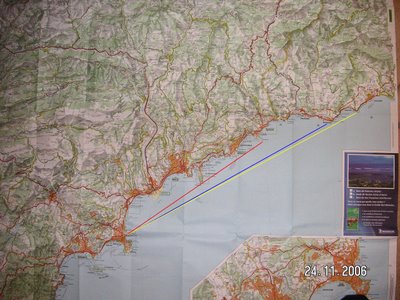
Every tourist guide I have looked at so far, bar one, gives the same answer : the Bordighera headland ( see map below). Follow the blue line on the map from left (Antibes) to right (Capo S Ampelio peninsula and Bordighera).


Sorry, it does not enlarge on clicking (possibly because it's been photo-edited)

The exception is Michelin’s Guide to the French Riviera, which has this to say:

(From Pointe Bacon on the Cap d'Antibes) one gets ........"a view of Antibes and Fort Carré extending across the Baie des Anges in front of Nice to Cap Ferrat and even Cap Martin near the Italian border. "

In other words, one follows the red sightline on the map, which does not even get as far as Italy !

Well, Monsieur Michelin, you may make good tyres, but your geography is awful. You see, Cap Martin is largely hidden from Antibes behind the Cap Ferrat peninsula.


But there’s another point worth mentioning: Cap Martin is a mere 35 km (approx 22 miles as the crow (seagull ?) flies from Antibes. That's less than the width of the English Channel at its narrowest, and we all know that the white cliffs of Dover are visible from France on a clear day.

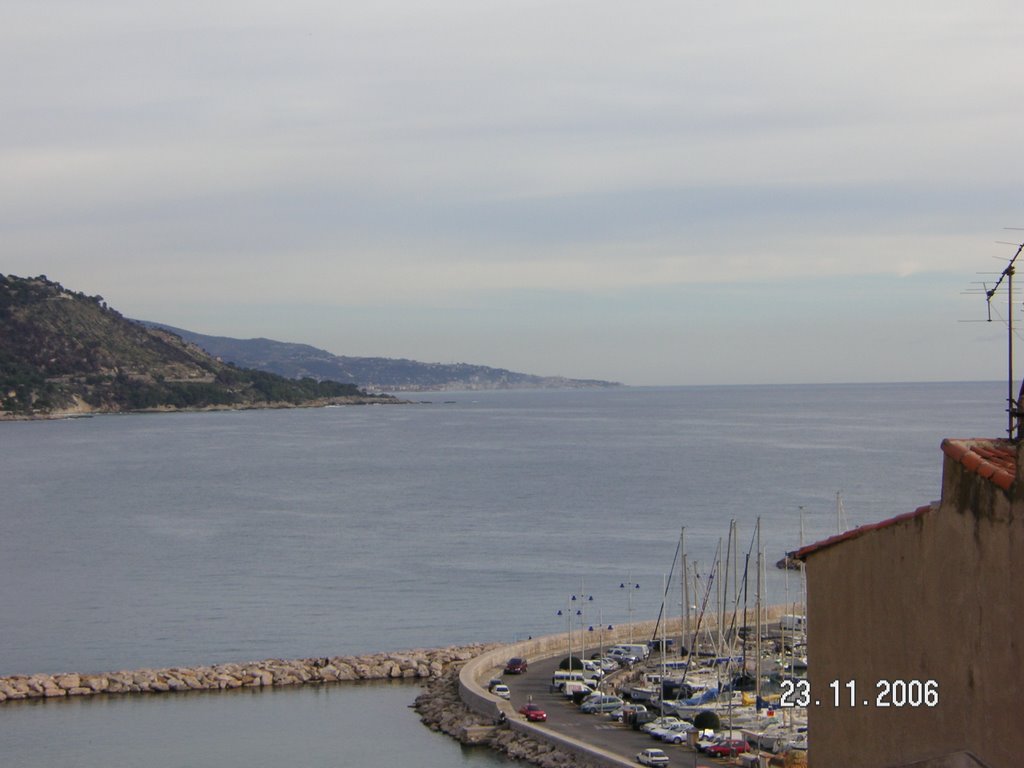
I was in Menton yesterday, that splendid Riviera town which is the last one before the Italian border


Here’s the view from the steps of the Cathedral, and yes - it is certainly the Bordighera peninsula that is the furthest one can see into Italy from Menton.


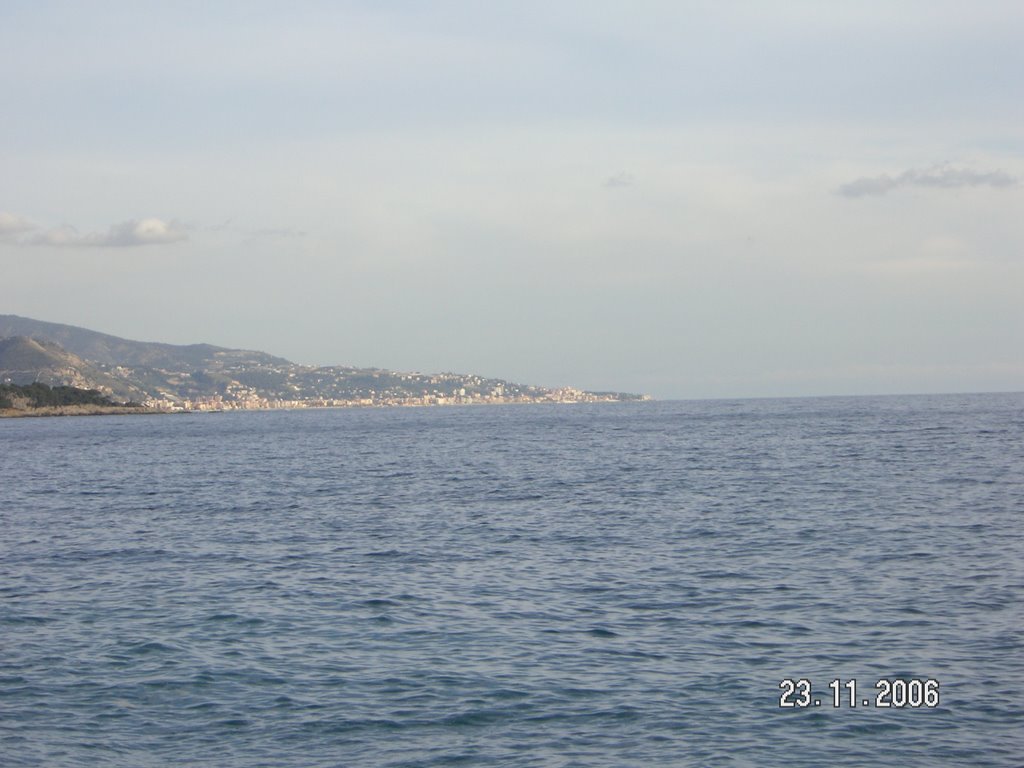
The next picture is the same view, on full zoom, from the promenade, taken with the benefit of a clearer sky.


One can just make out the raised clump of white buildings near the tip, which is Old Bordighera


But why do folk assume that what's true for Menton must be true for Antibes also ? Do they never look at a map ?

Bordighera is emphatically not the furthest one can see from ANTIBES. If you look at the map, one can see that next headland further east should be visible (follow the yellow sightline). It’s called Capo Nero, on which is situated the small resort town of Ospedaletti.

Here are two aerial pictures I took last year, on a flight heading eastwards out of Nice. The first is the Bordighera headland.


Most of the development is close to the shore line. There is little, not much, extending up the hills behind, but little of Bordighera itself is visible from Antibes, due to it being below the horizon.


Here is the next headland going east. It's a lot more dramatic. It has steep terraced sides, with greenhouses and other structures that are easy to spot and identify through binoculars or telescope from afar (if one knows what to look for).


Patient work with binoculars has confirmed without a doubt that it is this prominent headland that one sees on a clear day from Antibes. It is Capo Nero on which sits Ospedaletti . It is a few kilometres further along the coast than Bordighera.


Here is a sharper, lower angle picture of Ospedaletti off the internet, which I used to confirm identification:


Every guide book, then, that I've seen is wrong. And I would guess they will probably continue to stay wrong, given the tendency of received wisdom in books to be endlessly recycled. The pessimist in me says this blog won't make one iota of difference !

Just to the north of Ospedaletti, the autostrada (A10/E80) crosses a viaduct and goes into a tunnel. One can see it my aerial view. Both the viaduct and tunnel entrance are visible through glasses from Antibes . And what an eery sight it is to see the endless convoys of HGVs, through the heat haze. Do you recall that memorable scene in Lawrence of Arabia, in which Omar Sharif gradually emerges wraith-like from the desert. ? That’s how those HGVs look, viewed from 35 miles away across the Med.

Note I have not said that Capo Nero is the furthest one can see into Italy. More on that for another day, says he with a gleam in his eye.


Ed. Late addition: if you look up "Bordighera" in Wikipedia, you will find a photograph taken from Bordighera's little harbour, looking east. And guess what is in the background ? Correct: Capo Nero, with Ospedaletti just visible as a huddle on the shoreline.

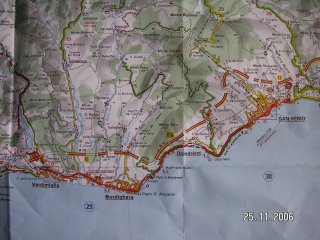
The map below shows the relationship between the Capo S Ampelio (Bordighera) and Capo Nero (Ospedaletti) in close up. This one has not been edited, so should enlarge on clicking.


To conclude: here are some pix taken yesterday in Menton that give a flavour of the place.

Up and till yesterday, I had only seen swallows on the wing, and was beginning to wonder if they ever roosted. Well, they do, on the upper stories of that fine belle époque hotel, the Palais de Toutou.


In the close up, you can see one on the wing, and several roosting.


Swallows are a discriminating lot, by the looks of it, liking to rest up in style , before heading back to winter in Africa. They presumably go via Corsica and Sardinia to minimize the time spent over water.

They say Corsica can be visible (just) from the Riviera mainland on clear cold days, especially February. I’ve seen a photograph taken from the celebrated Baou de St. Jeannet (the so-called Balcony of the Riviera, an iconic limestone outcrop , much favoured as a subject by painters). In that photo, Corsica's mountainous profile is just visible on the far horizon. We weren't able to see the so-called Ile de Beauté yesterday, or even its mountain tops , but there was maybe a hint of the island's cloud cover .


Here's the last hairdressing salon before the border.


I thought it had a nice name, with a certain ring to it. Anyway, we passed it on foot, heading towards to the border, where, just 50 metres beyond, we located Italy's first strategically-placed, correction, shamelessly placed, cut-price liquor store. It was deliberately sited, needless to say, to lure folk like ourselves across the frontier. Experience has taught us that one can buy spirits in Italy that (don't ask me why) are unavailable in our part of France, like Captain Morgan rum for example. And the excise duty is much lower too, so we have the equivalent down in this corner of France of a "booze cruise" in reverse.

Buggeration: no Captain Morgan. Looks like we'll have to wait for our next trip to Ventimiglia.


Sunday, November 05, 2006

O what a beautiful evening !

Here we are : hot from the digital camera. I took this picture just half an hour ago from our Velux, which faces roughly south-west . I have never in my life seen such a sky, with that amazing contrast between the red and turquoise. There's has been no photo-editing I assure you. Honest ! Note the date. Guy Fawkes is not celebrated in France, needless to say. Instead, Mother Nature has treated us to a kind of genteel "pyrotechnics", by way of compensation.